Psalms 92:10 But my horn shalt thou exalt like the horn of an unicorn: I shall be anointed with fresh oil.
---------------
Deuteronomy 33:17 His glory is like the firstling of his bullock, and his horns are like the horns of unicorns: with them he shall push the people together to the ends of the earth: and they are the ten thousands of Ephraim, and they are the thousands of Manasseh.
---------------
Job 39:9-10 Will the unicorn be willing to serve thee, or abide by thy crib? Canst thou bind the unicorn with his band in the furrow? or will he harrow the valleys after thee?
Job 39:11 Wilt thou trust him, because his strength is great? or wilt thou leave thy labour to him?
Job 39:12 Wilt thou believe him, that he will bring home thy seed, and gather it into thy barn?
---------------
Numbers 23:22 God brought them out of Egypt; he hath as it were the strength of an unicorn.
Numbers 24:8 God brought him forth out of Egypt; he hath as it were the strength of an unicorn: he shall eat up the nations his enemies, and shall break their bones, and pierce them through with his arrows.
--------------- .
Isaiah 34:7 And the unicorns shall come down with them, and the bullocks with the bulls; and their land shall be soaked with blood, and their dust made fat with fatness.
---------------
Deuteronomy 33:17 His glory is like the firstling of his bullock, and his horns are like the horns of unicorns: with them he shall push the people together to the ends of the earth: and they are the ten thousands of Ephraim, and they are the thousands of Manasseh.
---------------
Psalms 22:21 Save me from the lion's mouth: for thou hast heard me from the horns of the unicorns.
---------------
Descendants of Joseph (children of Ephraim) are symbolized by the unicorn.

Sunday, January 22, 2012

Unicorns of Europe

The image is of the Alicornio which has winged hooves.
LINKS
Unicorns in the Talmud http://www.jewishanswers.org/?p=3555
Unicorn of America


New York Times: A Horned Horse (click to read the article) was shipped into New York in 1887. Most of the inbreeding necessary for creating these genetic throwbacks is no longer in practice. A long time ago, horse's ancestor's certainly had horns! Finding a horned horse in any day and age is sure to be unusual.
Unicorn Dieties
Unicorn Dieties
Goddesses/Gods: Diana, Artemis (they pulled her Chariot of Chastity), Demeter (In some stories it is said that the cornucopia was inspired by the unicorn), Horned God, some moon gods and goddesses, Amalthea (more of a magical goat than god, whose horn was said to break off to form the cornucopia. Now, it is also the name of the unicorn in The Last Unicorn by Peter S. Beagle, which has flavored modern unicorn mythology extensively). The triple goddess corresponds to the unicorn, in that, the three colors of the Greek alicorn correspond with the three colors of the goddess. The unicorn is related to Ra and Sirus because of the unicorn's relation to the Egyptian Obelisk. The horn represents the sword/horn of the Judeo god.
Invisible Pink Unicorn (IPU)
Una
Mieliekki
Jehova
Jesus
Talmud Unicorn
Tiamat (births unicorns upon death)
Diana
Artemis
Unicorn on seal of Indus Valley
Kir'Rin Most Fortunate Animal of Asia
Amduscias (sometimes considered "demonic" in some circles)
ARTEMIS
Lately, the goddess who has been demanding my undivided attention has been.....Artemis! I have studied her quite a bit and she has gone through many transformations. For the most part she is a maiden goddess in the visage of the protector or defender. She is Greek, however she has been present in other mythologies under other names. Pure and strong, she did not seek the company of males and was a "virgin wife" or "eternal virgin" depending on the story. Often she is armed with a bow and protects women, virgins, children and animals. Sacred animals are the deer, hound and unicorn along with many others.
Well, I have a special place in my heart for any unicorn goddess, so its no big surprise I keep running across her. In fact, the golden hinds said to bear the Chariot of Chastity are actually golden unicorns in some older paintings. Perhaps it is the confusion of Christian mythology and how it flavors older "pagan" religions, perhaps it is something similar to that and alludes to a more masculine chariot. Her virginal "purity" is often what lures the masculine unicorn to the maiden's side. Often his downfall as hunters take him. Artemis is a hunter and she is the only one allowed to seek her sacred animals.
Apollo, the sun, is her brother, and Artemis is a moon goddess. This primal duality reflects the need for the twin powers to coincide with each other. Artemis even as a child (new moon) had to exercise her youthful energy by helping her mother flee Hera from the island the twins were born on. Throughout her waxing and waning energies however, she contains a strong sense of purity and purpose. Most moon goddesses have a triple aspect, and I suppose that Artemis has this when coupled with other Grecian goddesses that have lunar powers. However, she does not encompass them singularly as strongly as many of the other lunar goddesses in other cultures. You could put Selene, Hectate and Artemis together to create an obvious lunar trinity. However, it would be interesting to examine how Artemis as a singular goddess could represent the moon's cycles. I think that all women do. Although Artemis was never the "mother" or "crone" goddess, she did have elements that alluded to both. She is certainly a protector of mothers, though she herself never bore children. Her eternal youth bars her from the physical representation of the crone, but perhaps her natural and learned wisdom is symbolic of her crone-aspect.
The unicorn itself carries some elements to give it a triple symbolism itself. The triple colored unicorn horn is often colored in the symbolic goddess colors of red, black and white. Sometimes the unicorn is symbolized by the moon. Each month as the moon wanes to a sharp point in the sky, it recreates the unicorns horn. In mythology, this was related with the following story. The lion in the sky ran around the earth chasing the unicorn. The unicorn would wax and grow strong and suddenly, the lion, hungry, would challenge the unicorn. The unicorn would then sharpen the horn, and turn on the lion. However, the lion would devour the unicorn (during the new moon when it would disappear). The unicorn is immortal though, and soon, the sharp horn would be visible in the sky, and the unicorn and lion's celestial pursuit would continue next month.
An ancient "Horned God" the unicorn is a fitting companion for the forever-pure Artemis. Like the Horned Lord of many myths, the unicorn is sacrificed. The story goes that a woman (usually implied to be virginal by some people who care about that, and even rich or beautiful by other standards) draw out the unicorn. The unicorn comes out of the safety of the forest and lays his head in a maiden's lap. She is a terrified witness to hunters who had tricked her into luring the beast attack. Sometimes she is active in catching the unicorn, and sometimes the woman or hunters are evil, but at other times they are good. The story of the horned lord is one which found its way throughout nearly all mythologies of the world, simply through the unicorn alone. A good, divine creature, immortal and sacred gives its life to humanity that they too may find immortality and be cleansed. Of course, this very closely matches horned lord stories, especially sacrifice stories, implying that the "Horned God" gives his life so that people gain a powerful benefit (usually supernatural like immunity to poison, disease and immortality). Artemis as divine huntress has her own stories where she hunts all sorts of animals. I have even heard stories of her hunting unicorns.
Either way, the unicorn and Artemis tie is very strong. She is a Goddess, symbolized in the past by unicorns and is both hunter and guardian of the sacred animal. As you continue your quest, remember, the unicorn is found in many places, it has stood beside gods, lords, kings, paupers and religious people all over the world. It is one of the most prevalent magical animals in myth and story and it is certainly one that will continue to lure us into magical forests.
Source:
Faeries 101 by Doreen Virtue
Creating Magickal Entities: A Complete Guide to Entity Creation: by David Michael Cunningham (Author), Taylor Ellwood (Author), T. Amanda R. Wagener (Author)
http://www.loggia.com/myth/selene.html
Lore of the Unicorn by Odell Shephard
http://www.pantheon.org/articles/a/artemis.html
The White Goddess
Invisible Pink Unicorn
Biblical Unicorn/Jesus: See Page on Biblical Unicorn
Sacred Birds, Avians, Phoenix, Simurgh and More
Mundane Birds
Albatross
Nicknames: King of the Ocean Waves, King of the Sea, Sacred AlbatrossAlbatross is a large seabird from the family Diomedeidae (full of other large sea birds). Their range is from the Southern Ocean and the North Pacific but there have been fossils of the bird's predecessors found at a winder range. The might albatross has the longest wingspans of any extant birds. Its magnificent wings stretch up to 3.7 meters (12 feet) tip to tip. They are one of the largest of flying birds. They are known for their famously beautiful ritual mating dances. Pair bonds form over years. Fish, krill and squid make up a good portion of their diet as they dive, scavenge and surface seize their food. They are long lived. A Laysan albatross, named Wisdom, was banded in 1956.
Albatross Totem: There will always be new pathways to take. New pathways will eventually take us where we want to go. Improved Relationship with others. Benefit when living hear coasts and islands. Because of the wandering nature and desire for monogamy, Albatross needs to be in love to be grounded in their relationship physically.
Albatross Energy and Totem Talents/Gifts: luck, grace, long distance travel, largeness/being big, longevity/long life, stamina, independence, monogamy, nonconformity, dancing, ritual, faithfulness, messenger, loyalty, calm, open minded, lenient, restless, forecasting weather, controlling winds and storms, working with the energy present to make what you want to happen, freedom of belief, freedom of adopting another culture, enlightenment, freedom of speech, guidance, value others, reuniting spouses, keeping spouses together, king of the sea, largest of birds, dealing with emotions, manage stress, excellent parenting, wandering spirit, may like long distance relationships, can break through self-imposed limits, messages from the spirit world, faithfulness, depressive, air-headed, restless, lazy, and lenient
Albatross Associations: Other sea birds
Primary Element: Air
Secondary Elements: Water, Earth
Opposing Element: Fire
Direction: South
Time of Day: Afternoon
Color: Pale White
Season: Autumn
Moon Phase: Crescent Moon
Common star signs: Gemini, Libra, Aquarius
The Albatross Challenges: The symbolism of an albatross bound around one's neck. This represents a physical burden that makes you feel as though you are cursed or carrying a burden. If you have albatross totem yet fear it, you may fear your emotions getting out of control. You may fear being overwhelmed. You may fear the internal currents of life.
Ancient Lore: Albatrosses are symbols of great luck. They were adored by sailors. It was said to communicate between earthly and heavenly realms. Sailors thought it was made of fog and a supernatural bird. Seeing an albatross die was a terrible omen. Oddly, tobacco pouches were made from their feet though.
Albatross in Love: Albatrosses only are on land to mate. They form large breeding colonies. At around 12 years old they lay one egg. Parents take turns keeping the egg warm. Baby albatrosses must be 3-10 months old depending on the species to fly. They dance all over looking for a mate. Albatrosses put a lot into their relationships and so do people with albatross totem.
RESOURCES
Animal Totems and Symbolism. Albatross. soulofvoltaire.tripod.com/id6.…
www.auntyflo.com/magic/albatro…
Raven/Crow/Corvid
Mysteries, wisdom, magic, balance, life mystery, magic, initiation, discovery, shiny stuff, collecting, teamwork, intelligence, problem solving
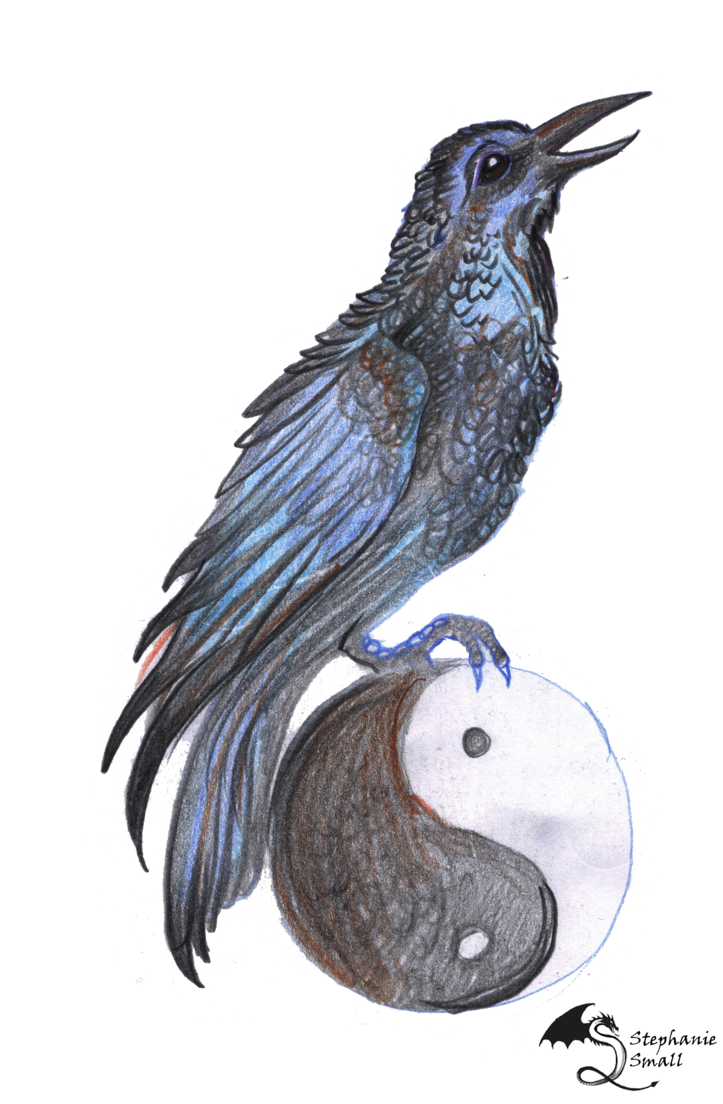
Ravens and crows are said to be messengers to the underworld. Odin has 2 raven companions.
Owl
Owl is wisdom, intelligence, seeing in the dark, seeing the unseen, piercing the veil, magic, the Goddess
Eagle/Hawk
Wisdom, Leadership, power, magic, initiating into mysteries
Vulture
Magic, wisdom, greeting the morning, solar/sun magic, death/funerary rites
Toucan
Toucan carries the energy of showmanship, communication and a desire to be heard and seen.
Great Heron
Wisdom, good judgement, resourcefulness, stillness, tranquiity
Flamingo
Fun, relaxation, time for fun, spending time with friends
Peacock
Integrity, Beauty, Balance, Wisdom, Vision, Awakening, Immortality, Spirituality, Self-confidence, Awareness, Leadership, Self-love, Resurrection, Laughing at life
Woodpecker
opportunity knocking at your door, rythm, dreams, intuition, attention, communication, creativity, cycles and more, here's a good page: https://www.spirit-animals.com/woodpecker-symbolism/
Roadrunner
diplomacy, communication, take quick action, get motivated, protection from evil, good luck, wards, sacred,
http://www.native-languages.org/legends-roadrunner.htm
Chicken/Rooster/Hen
Happiness, blessings, fertility, sexuality, birth, children, poultry
Condor
California condor is largeness, huge, powerful, grand energy and strength.
Fantasy Birds

Simurgh cousin to the Phoenix
Simurgh: Phoenix's Cousin....Lost in Obscurity
Manuscript of a Forgotten King
The Simurgh, Truth's last flawless jewel, the light
In which you will be lost to mortal sight,
Dispersed to nothingness until once more
You find in Me the selves you were before.'"
-Mantiq al-Tayr, or the Parliament of Birds
The rebirth of popular fantasy has stimulated a resurrection of many mythological beings, renewing the moral and ethical value of those creatures. One creature that held a powerful mythological position that has since fallen into obscurity was the Persian bird the Simurgh. The creature is also called the Sna-Mr, Senmurv (S?nmurw and older S?nmuru), Sirng and Simorgh, but I will refer to it as the Simurgh for simplicity's sake for the rest of this investigation. The name is derived from Avestan m?r? Sa?n? which can be deciphered into "the bird Sana". This bird was most likely a raptor, such as an eagle, falcon or sparrowhawk, and the word looks related to the Sanskrit word yena, a elysian being. Sana is also believed to be a personal name derived from the bird name. The etymological origins of the Simurgh give a rather unique description of this powerful beast.
The physical appearance of this bird varies from region to region, yet some features remain unchanged throughout accounts. The most common description of this animal is as a bird with the tail of a peacock, dog's head, claws of a three-toed lion and four wings. Some accounts say the birds feathers were copper and others say the bird's feathers were comprised of thirty different colors. The creature often is said to have the head of a man or bird instead of a dog. It was rumored to be a very large bird that could carry an elephant or a camel. Some stories say the simurgh had thirty holes in its beak and blew air through the holes to attract prey with the enchanting music it produced. The features of the Simurgh symbolize the metaphysical and fundamental fertile nature of the bird that has contributed to many religions.
The mythology of the Simurgh is rich and varied, colored with regional stories and beliefs, but it all comes down to a general symbol of fertility and enlightenment. This long-lived bird was said to be over 1,700-2,000 years old and ancient enough to have seen the world destroyed three times. The touch of its wings was purported to cure illnesses and heal the wounded. The bird was an attendant to the Queen of Sheba, the wealthy queen of what many believe is located in present-day Ethiopia or Yemen. She has been compared to Lilith, a feminine sexual being, later demonized to promote masculine power. The Simurgh is also a fertility being and it's presence with the Queen of Sheba may be a symbolic way of representing the fertility connection.
The mythology of the Simurgh is similar to the mythology attributed to the bat, Phoenix and the Roc. Some say that the Simurgh is related to the bat because the bat flies like a bird, has the head and teeth of a dog yet lives in a cave like a muscat. The Simurgh is said to suckle its young, as it is part mammal (lion, dog or human) and has teeth, making it similar to a bat. Some stories call the Simurgh a bat but it is usually referred to as a bird. The bat and the Simurgh have otherwise been different creatures in mythology and do not seem to be the same being due to its connections to other creatures. One Iranian account noted that the Simurgh would destroy itself after 1,700 years in a conflagration, comparing itself to the Phoenix mythology. In the Shahname, it was known that should you burn the one of the feathers it would summon the bird, relating it to the fiery Phoenix. The large size of the creature can be found akin to that of the Roc, another gigantic bird. Despite its influence by and on other beings, the Simurgh stands alone as a rather unique being in most traditions.
The bird was one of the attendants to the conference of birds and was later crowned the king of birds. In the Mantiq al-Tayr, or the Parliament of Birds, the quest for the Simurgh is undertaken by thousands of birds so they have a king. The birds travel through the seven valleys of the quest, love, understanding, independence and detachment, unity, astonishment, and finally poverty and nothingness but only thirty birds finish the quest. These thirty birds then discover that together they are the Simurgh, which literally means thirty birds. They then sacrifice their individuality and merge to become the Simurgh. Through this, they discover immortality, secrets and wisdom. This means that through their lack of ego (displayed by their self sacrifice into a single consciousness), they can attain enlightenment. It is this symbolism of completion, healing and joy that permeates the Simurgh mythology and may also be related to the Persian fertility beliefs.
There are many stories of the Simurgh's benevolence and magic, although I will only detail one at this time that supports the fertility symbolism. The Simurgh was first popularized in Ferdowsi's Shahname (Book of Kings), where Prince Zal, the albino son of Saam was believed to be a devil and was abandoned as an infant on the mountain Alborz. The tenderhearted Simurgh heard the babies cries and saved the baby, raising it as her own. She taught it wisdom and when he grew she selflessly gifted him with a single golden feather to burn if he ever needed her assistance. Zal returned to his kingdom where he married Rudaba. When their son was being born the birth was excruciating and prolonged. Zal, knowing Rudaba would die in childbirth summoned the Simurgh who appeared and taught him how to perform a cesarean section. This saved the babe and Rudaba. The baby grew into Rostam, one of Persia's great heroes. This power over life and death through ancient secrets, wisdom and magic support the fundamental religion of the region.
Persian mythology believed that since the Simurgh loved to nest in water-rich areas, it would bring blessings and fertility to the land through its innate magic and wisdom. Persians say the bird lived in Gaokerena, the tree of life and sometimes call the bird Homa. Some stories say that the Simurgh nested in the Tree of Knowledge, and when it took flight, the leaves shook seeds to the ground creating all the plants of the earth and healing all the illnesses. Said to be related to the Aquila and Sirius constellations, the celestial bird has a place in astronomy as both bird and dog and has its roots in Babylonian mythology. The movement of these constellations can be used to measure the seasons, particularly the influence of the rainy season. This correlation may lend support to the Simurgh's preference for wetlands. The enemy of the Simurgh is the Kamak, an avian bringer of drought. The bird would savagely eat humans and animals, slaughtering hundreds. This evil bird was killed by Karshsp, a hero, who had to shower it with thousands of arrows until the bird perished. It was this kinship to water and the opposition to drought that reiterated the Iranian and Persian duality of light and darkness.
This fundamental belief as a dual king-being is a basis for Persian mythology that continues to support the validity of ancient symbols like the Simurgh. These symbols can be used today to relate complex moral and mythological ideals. As the quote "The Simurgh, Truth's last flawless jewel" implies, the symbolism still holds true as an excellent symbol for enlightenment. This also implies that you will be lost to "unenlightened" people in your quest until you loose yourself into a divine wholeness and become a leader or king for those people. The duality of the creature in its need for the "unenlightened" to define it from the "enlightened" implies the need to define the good from evil. The ancient stories of creatures such as the Simurgh begin to dissipate, yet as our current moral ethics begin to change, we cannot forget the old wisdom that can still teach us lost lessons.

Phoenix
This bird renews itself in fires on top of a palm tree nest.

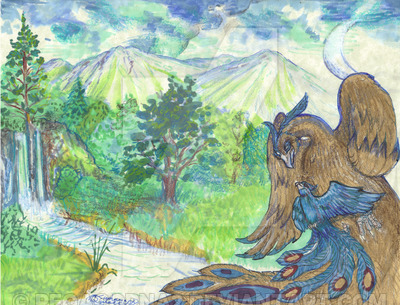
Pheonixes have been described in a variety of colors though they usually say there is only one at a time...

Some accounts of pheonix describe it as red or purple with 8 large feathers.

Some describe a more "pheasant like" pheonix, even rooster-like descriptions exist!

Sacred marriages are said to be combinations of magical energy.

The phoenix represented fire, and is often described as being ideally married to dragon (air).


The phoenix is one of the "Most Fortunate Animals" of some Asian religions.
The four most fortunate animals of (some) Asian mythologies, the kirin Unicorn (kirin or Kir'rin), Dragon, Tortoise (or turtle dragon or sea monster) and phoenix. The sacred female unicorn and sacred male unicorn (from religions up to around 40,000 years old) and some celtic knotwork. The Sacred vessel of life in the center...
Roc
This giant bird is said to have a wingspan of 60 feet or more! Sightings continue to this day, even some close to me (Sacramento, CA)


Egyptian Phoenix
(Associated with a sacred solar Tablet)
Guksu
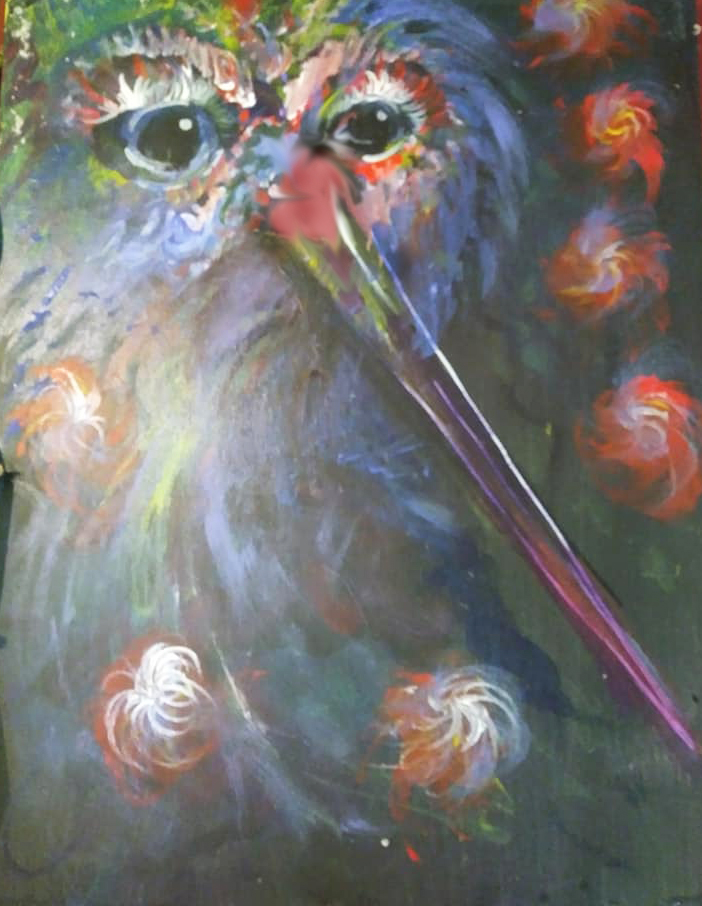
Honored by the Pomo Tribe, this is Guksu, symbolized by a rainbow bird or a cranefly. It has a pointed nose/horn/beak with balls of feathers surrounding him. To learn more about him, go here: https://sacredunicorn.blogspot.com/2011/05/pomo-magic-and-lore-wip.html
Adar Llwch Gwin
These giant birds were a gift to Drudwas ap Tryffin and they could understand humans. They edid what their master told them to do. They turned on Drudwas when he commanded them to attack the first man on the battlefield. Arthur was late to the field though, and Drudwas was destroyed. They wailed when they realized what they had done. Though often described as giant birds, they are also sometimes equated with griffons. To learn more about griffons go here: https://sacredunicorn.blogspot.com/2015/03/griffon-in-magick.html
Their name is from the Welsh words llwch ("dust") and gwin ("wine"). The name also refers to brave men and raptors in poetry.
For more metaphysical information I suggest visiting: http://encyclopedia.creepyhollows.com/article_creature_adarllwchgwin.html
Griffons
Griffon have their own page at: https://sacredunicorn.blogspot.com/2015/03/griffon-in-magick.html
Resources
Pagan Clothing Colors

by Tariel Nimara
Your religion should not dictate how you dress, but you should dress for *magickal* success. If you are going to devote yourself to a religion that favors diversity, then by all means, wear whatever colors you desire!
I am pagan, and I do wear mostly black, but I also know that colors have metaphysical and magical qualities! Below, I have included a list of colors and their qualities! That can give you some ideas if you want to dress for success! Wear colors that augment your spells, feelings you want to have or even forms of prosperity you want drawn to you.
White
The Goddess
Higher Self
Purity
Peace
Virginity
(substitutes any other color)
Black
Binding
Shapeshifting
Protection
Repels Negativity
Brown
Special Favors
To Influence Friendships
Silver
The Goddess
Astral energy
Female energy
Telepathy
Clairvoyance
Intuition
Dreams
Purple
Third Eye
Psychic Ability
Hidden Knowledge
To Influence People in High Places
Spiritual Power
Blue
Element of Water
Wisdom
Protection
Calm
Good Fortune
Opening Blocked Communication
Spiritual Inspiration
Green
The Element of Earth
Physical Healing
Monetary success
Mother Earth
Tree and Plant Magic
Growth
Personal Goals
Pink
Affection
Romance
Affection
Caring
Nurturing
Planetary Good Will
Red
Element of Fire
Passion
Strength
Fast action
Career Goals
Lust
Driving Force
Survival
Blood of the Moon
Orange
General Success
Property Deals
Legal matters
Justice
Selling
Copper
Professional Growth
Business Fertility
Career Maneuvers
Passion
Money Goals
Gold
The God
Promote Winning
Power of the Male
Happiness
Yellow
The Element of Air
Intelligence
The Sun
Memory
Logical Imagination
To Accelerate Learning
To Break Mental Blocks
Unicorns: A Metaphysical Study
Unicorns: A Metaphysical Study

THIS IS AN EXCERPT! PLEASE READ THE WHOLE THING: Mythology: Unicorns and other Horned Beasts
Unicorns are fascinating and wonderful creatures with a rich and varied history. Magickally, unicorns can provide wonderful guides for all types of people. There are many types of unicorns that can be called upon for aid. The unicorn is one of the oldest beings and the revival of metaphysical interest has sparked its rebirth.
The unicorn has appeared in movies, tapestries, cave drawing, bestiaries, reliefs, mosaics, sculptures, paintings, ancient vases and more! Many people envision the unicorn as a white horse with a single straight horn emerging from its forehead, however, this is only one of many unicorn descriptions. The unicorn of Ctesias was a red ass with a tri-colored horn. There were unicorns with the tails of lions, asses, pigs or even serpents. Unicorns have had cloven hooves, horses hooves, claws and elephant feet. There have been furred, scaled and even armored unicorns. They have been as small as cats and described to be bigger than ships. The variation of the unicorn in legend and lore is different by time, region, culture and more.
Unicorns have changed throughout the years, and the legends surrounding them often differ. I am going to present some of the more common stories. I want to assure you, if I could include all the differing renditions of each mythology, I certainly would. However, there are many books available on the subject and I will include some websites and books for further study.
-
Because this is primarily a metaphysical study I will not be going into the animals which have been often referred to as unicorns (rhinoceros, dinosaurs, bulls, narwhal ect). For more information on such creatures, I recommend checking out the recommended reading in the end of the program.
The term Alicorn is the traditional word to describe the unicorn's horn. In recent years, it has also come to be the term for the winged unicorn. However, I will not be referring to a winged unicorn by that term. I will instead use the Greek cerapter to avoid confusion.
THIS IS AN EXCERPT! PLEASE READ THE WHOLE THING: Mythology: Unicorns and other Horned Beasts
To continue reading, please go to the link below. This is a very very long article with lots of details and information. I go over all the breeds, lots of interesting history and more. Enjoy. THIS IS AN EXCERPT! PLEASE READ THE WHOLE THING: Mythology: Unicorns and other Horned Beasts

THIS IS AN EXCERPT! PLEASE READ THE WHOLE THING: Mythology: Unicorns and other Horned Beasts
Unicorns are fascinating and wonderful creatures with a rich and varied history. Magickally, unicorns can provide wonderful guides for all types of people. There are many types of unicorns that can be called upon for aid. The unicorn is one of the oldest beings and the revival of metaphysical interest has sparked its rebirth.
The unicorn has appeared in movies, tapestries, cave drawing, bestiaries, reliefs, mosaics, sculptures, paintings, ancient vases and more! Many people envision the unicorn as a white horse with a single straight horn emerging from its forehead, however, this is only one of many unicorn descriptions. The unicorn of Ctesias was a red ass with a tri-colored horn. There were unicorns with the tails of lions, asses, pigs or even serpents. Unicorns have had cloven hooves, horses hooves, claws and elephant feet. There have been furred, scaled and even armored unicorns. They have been as small as cats and described to be bigger than ships. The variation of the unicorn in legend and lore is different by time, region, culture and more.
Unicorns have changed throughout the years, and the legends surrounding them often differ. I am going to present some of the more common stories. I want to assure you, if I could include all the differing renditions of each mythology, I certainly would. However, there are many books available on the subject and I will include some websites and books for further study.
-
Because this is primarily a metaphysical study I will not be going into the animals which have been often referred to as unicorns (rhinoceros, dinosaurs, bulls, narwhal ect). For more information on such creatures, I recommend checking out the recommended reading in the end of the program.
The term Alicorn is the traditional word to describe the unicorn's horn. In recent years, it has also come to be the term for the winged unicorn. However, I will not be referring to a winged unicorn by that term. I will instead use the Greek cerapter to avoid confusion.
THIS IS AN EXCERPT! PLEASE READ THE WHOLE THING: Mythology: Unicorns and other Horned Beasts
To continue reading, please go to the link below. This is a very very long article with lots of details and information. I go over all the breeds, lots of interesting history and more. Enjoy. THIS IS AN EXCERPT! PLEASE READ THE WHOLE THING: Mythology: Unicorns and other Horned Beasts
Subscribe to:
Posts (Atom)